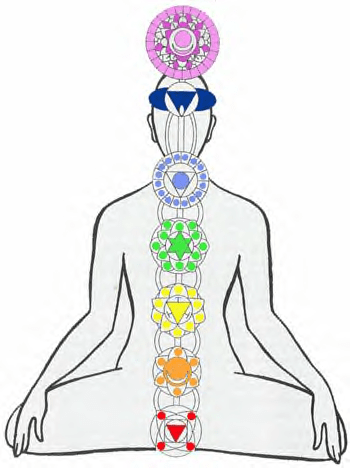
Learn the complete story about the seven chakras and their relationship with the three Ayurvedic doshas. How should you feel when the chakras are in balance and what would you expect to experience when they are out of balance.
LEARN THE MYSTERIES OF THE PAST, PRESENT AND FUTURE
DISCOVER THE MEANING OF LIFE, DEATH AND BEYOND
Did you ever wonder what life is all about? Did you ever ask the question, “What is the meaning of life?” Did you ever ponder over your purpose for living, and, if so, how do you know what it is? Why were you born and why are you here? Were you placed here for a special reason? Or are we here to merely enjoy ourselves or else to be miserable? It seems that materialism and hedonism are rampant in our modern day society. Is this our life’s purpose or are we missing something? Is there a greater purpose in life or are we just born, get through life, and then die no matter how good or bad we had it during our lifetime? Do we get one chance and only one chance in living this life? What happens if we screw up in this life; is there a do over, an ultimate Mulligan? Is it true that “life is a bitch, and then you die?” This would be sad if that is all to life. Why are some people very rich while others are poor? Is it the luck of the draw? Why are some people born healthy and some are born infirmed?
Themeaning of life is not only a philosophical and psychological query into our lives, but also extends to religious, spiritual and theological aspects of our belief system. Alternative questions include; “Why was I born?”, “Why am I here?”, “Do I have a purpose in life?”, “What is my purpose in life?”, and “What is life all about?” These kinds of perplexing questions have been the subject of considerable scientific, philosophical, and religious debate throughout the centuries. The proposed answers to these kinds of questions are quite varied, diverse, and controversial usually depending upon one’s own personal background and cultural biases.
There is so much controversy between creationism and evolution. The Theory of Evolution postulates that man evolved from the lower animal species, which eventually developed from the primordial slime of early earth. Some people claim man evolved from the proverbial “ape”; and creationists teach that God made man de novo from the do-called slime of the earth and that man did not evolve from the lower animals. In Chapter 2 in the Book of Genesis, And the Lord God formed man of the slime of the earth; and breathed into his face the breath of life, and man became a living soul (Gen.2:7 DRA). We were taught that God made man in His own image and likeness. How do we know what to believe?
In his book on reincarnation, Swami Abhedananda (S.A.) references the Theory of Transmigration and states that this theory of Transmigration has been accepted by the people of India and the orient for thousands of years. It explains the questions of life, death, and the afterlife, that is the perpetual existence of the soul following death of the human body. The theory is based on the supposition that the spirit or soul (atma) continues to exist following death and dissolution of the material body, and does not rely on a physical entity to exist. Deniers of the existence of the soul as a separate entity free from physical existence consequently must also deny the theory of transmigration. The soul or spirit is a living energy that exists on a much higher energy plane and higher dimension so that is cannot be observed, quantified, measured or evaluated by our modern scientific methodologies. Thus, agnostic scientists and non-believers deny the existence of the individual spirit (soul) or anything beyond physical analysis or experimentation by their limited physical senses and experimentation, as explained by S.A.. Thus the soul that exists on this higher energy level cannot be perceived by current scientific methods.
Ultimately, soul development and spiritual progress during our physical existence on Earth depend upon what level of righteous behavior we exhibit. This behavior includes unconditional love, forgiveness, compassion, good works, and helping others. These virtues exemplify the level of the fourth chakra, as discussed in my book, Mysteries of Life, Death and Beyond. It is because, at this level of spiritual achievement, our immortal soul will continue to exist in the afterlife. No one likes to think about death, but it is inevitable. Achieving the highest level of the chakras or spiritual enlightenment in this life will help prepare our spirit for eternal bliss and joy in the afterlife. If we die with our consciousness mired in the lower chakras and negative karma, we will not experience all of God’s blessings and heavenly bliss. Otherwise, we are probably doomed to undergo repeat reincarnations until we get it right. Do not waste this lifetime; this is your golden opportunity to achieve eternal and true happiness. Otherwise, you will be destined to relive your mistakes many times over again. Your next lifetime may be a lot worse than your current lifetime; worse yet, you will have accrued more Karmic debt for which you must atone. Start today; it is never too late during this lifetime.
Our spirit is also an energy that cannot be destroyed and is continuously seeking perfection. Perfection can only be achieved by purification through the elimination of the shackles of karma. Life on earth can be complicated. The ancient gods from Nibiru fashioned humankind utilizing their DNA to become Primitive Workers to assist the Anunnaki mining the gold in southern Africa. A strange being called Galzu, a Divine Emissary, directed these ancient gods to save humankind from the ravages of the great Deluge and to leave Earth to the Earthlings. The evolution of these Earthlings, unknown to Enki and Ninmah at that time, provided the physical existence not only to help serve the gods but also for souls reincarnating into physical form. In this way, our souls entered our physical bodies to help remove our karmic debts.
But take comfort, although there are times we feel despondent, alone, and confused in this lifetime. The spiritual world is a reality, and we have loving spiritual guides and guardians to help us get through this life. We affectionately refer to them as our angels. These spiritual beings realize the complexities and difficulties we experience during our lifetimes on Earth, and they are here to help. All we have to do is ask for their help. Unfortunately, we do not realize or accept these beings in our lives. We may shun them from our lives or be totally unaware that they exist. Just because we cannot see them it does not mean that they do not exist. They only exist in a non-physical form of energy, spiritual energy – but they exist if you allow them into your heart.
Many times when I personally experienced mishaps and confusion in my life, I felt a guiding hand helping me. I know others have experienced the same feelings. One time I prayed to my spirit guides and guardians at night and asked for a specific sign in the morning to indicate that they are listening. To my amazement, the sign appeared the next morning. I am not trying to convince anyone that there is a spiritual world out there, but if you believe, a sign will appear. When good things, whether great or minor, occur, I thank my guides, and they frequently respond. They appreciate gratitude. As Marcus Tullius Cicero said, “Gratitude is not only the greatest of all virtues but the parent of all the others.” We tend to think we are alone and may become frightened, but our guides and guardians are always there to provide comfort and protection. All we have to do is to pray to them, and they will guide us. Ask them to direct your path. When bad things happen, it may be a sign to redirect your path in life, or this may be a means to help eliminate negative karma. You may see only one set of footprints on your lonely path, but they may not be yours. Sometimes we get carried over the finish line.
The wise and spiritually evolved rishis or seers of ancient India applied the principles of Karma to demonstrate the destiny of human souls, and developed the theory of transmigration. This is one of the oldest accepted theories by Asians and explains continuity of the individual cosmic consciousness or soul between life and death. This theory of transmigration considers that the soul is an entity that can exist without a living physical human body. The matter (body) is totally converted into energy (soul). Naysayers deny the existence of a soul and claim that when the body dies all its chemical and neurologic functions cease and the vital life giving energy dissipates. Materialists deny anything that they cannot measure, observe, or perceive by any of their senses. When someone blows a dog whistle, no sound is heard by the human ear. Does that mean that no sound was produced? Then why do the dogs’ ears perk up and the dog comes running? That sound does exist but is it beyond our limited senses and does not record on the decibel scale. So too many of existence is beyond our senses but does not negate its existence. The spiritual world exists at a much higher energy level that we cannot perceive with our limited senses and equipment. Those that deny the theory of transmigration, claim that at the time of birth, God creates and infuses a brand new soul into the developing human fetus. This soul lasts for only one life time and, after death, ascends into paradise or suffers for all -eternity in hell. This hypothesis is incorrect because what exists now always existed and is in conformity with the First Law of Thermodynamics that indicates that matter and energy cannot be created or destroyed and must remain constant. Matter and energy, however, are transmutable but the total amount of energy and matter in the universe does not change.
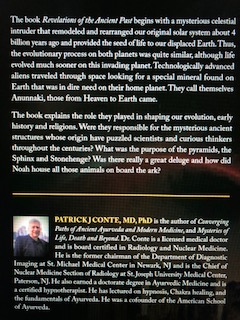
Patrick J Conte, MD, PhD is the author of Converging Paths of Ancient Ayurveda and Modern Medicine, and Mysteries of Life, Death and Beyond. Dr. Conte is a licensed medical doctor and is board certified in Radiology and Nuclear Medicine. He is the former chairman of the Department of Diagnostic Imaging at St. Michael Medical Center in Newark, NJ and is the Chief of Nuclear Medicine Section of Radiology at St. Joseph University Medical Center, Paterson, NJ. He also earned a doctorate degree in Ayurvedic Medicine and is a certified hypnotherapist. He has lectured on hypnosis, Chakra healing, and the fundamentals of Ayurveda. He was a cofounder of the American School of Ayurveda. Recently, he earned a doctorate degree in Neuroscience Acupuncture from the internationally accredited Akamai University.
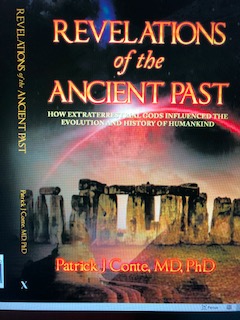
Later, highly developed and technologically advanced beings from this misplaced planet traveled through space looking for a special mineral found on Earth that was in dire need on their home planet, Nibiru. This occurred some 450,000 years ago. Their home planet spends most of its time in deep outer space and has an extremely long orbit taking 3,600 years for one revolution around our sun. It is sometimes referred to as planet X, since it was considered the 10th planet. They called themselves the Anunnaki, from Heaven to Earth came. They first set up their home in the area between the two rivers, the Tigris and the Euphrates, in Mesopotamia. A spaceport and command center were established on the Earth and a way station set up on Mars for the purpose of transporting this precious mineral back to Nibiru by rocket ship. Mining operations were established in southern Africa but the Anunnaki miners were not use to such hot temperatures and complained bitterly. They threatened mutiny demanding more help. This prompted the gods to accelerate our evolutionary process and eventually creating Homo sapiens sapiens. There was intimate interaction between the Anunnaki and humankind for many thousands of years. They allowed us to partake in the Tree of Knowing but these immortal gods withheld passing on their Tree of Life to humankind.
The Anunnaki are the gods of the Old Testament and the so-called mythological gods of Egypt, Greece and Rome. The book clarifies many of the bible stories written in Genesis 1 and describes the circumstances behind the stories. It shows the Great Deluge was real and the reason why it occurred. Furthermore, the book describes the facts behind the building Noah’s Ark and how they brought all those animals on board. Did the All Merciful God cause the flood to happen to destroy the sinning humans? Little did The Anunnaki gods know that their actions were being monitored and the fate of humankind was being observed and protected by a shadowy “Divine Emissary.”
In order to bring the purpose of humankind into perspective, the book concludes with sections on Karma, reincarnation and spirituality.
This is an example post, originally published as part of Blogging University. Enroll in one of our ten programs, and start your blog right.
You’re going to publish a post today. Don’t worry about how your blog looks. Don’t worry if you haven’t given it a name yet, or you’re feeling overwhelmed. Just click the “New Post” button, and tell us why you’re here.
Why do this?
Because it gives new readers context. What are you about? Why should they read your blog?
Because it will help you focus your own ideas about your blog and what you’d like to do with it.
The post can be short or long, a personal intro to your life or a bloggy mission statement, a manifesto for the future or a simple outline of your the types of things you hope to publish.
To help you get started, here are a few questions:
Why are you blogging publicly, rather than keeping a personal journal?
What topics do you think you’ll write about?
Who would you love to connect with via your blog?
If you blog successfully throughout the next year, what would you hope to have accomplished?
You’re not locked into any of this; one of the wonderful things about blogs is how they constantly evolve as we learn, grow, and interact with one another — but it’s good to know where and why you started, and articulating your goals may just give you a few other post ideas.
Can’t think how to get started? Just write the first thing that pops into your head. Anne Lamott, author of a book on writing we love, says that you need to give yourself permission to write a “crappy first draft”. Anne makes a great point — just start writing, and worry about editing it later.
When you’re ready to publish, give your post three to five tags that describe your blog’s focus — writing, photography, fiction, parenting, food, cars, movies, sports, whatever. These tags will help others who care about your topics find you in the Reader. Make sure one of the tags is “zerotohero,” so other new bloggers can find you, too.
This is an example post, originally published as part of Blogging University. Enroll in one of our ten programs, and start your blog right.
You’re going to publish a post today. Don’t worry about how your blog looks. Don’t worry if you haven’t given it a name yet, or you’re feeling overwhelmed. Just click the “New Post” button, and tell us why you’re here.
Why do this?
Because it gives new readers context. What are you about? Why should they read your blog?
Because it will help you focus your own ideas about your blog and what you’d like to do with it.
The post can be short or long, a personal intro to your life or a bloggy mission statement, a manifesto for the future or a simple outline of your the types of things you hope to publish.
To help you get started, here are a few questions:
Why are you blogging publicly, rather than keeping a personal journal?
What topics do you think you’ll write about?
Who would you love to connect with via your blog?
If you blog successfully throughout the next year, what would you hope to have accomplished?
You’re not locked into any of this; one of the wonderful things about blogs is how they constantly evolve as we learn, grow, and interact with one another — but it’s good to know where and why you started, and articulating your goals may just give you a few other post ideas.
Can’t think how to get started? Just write the first thing that pops into your head. Anne Lamott, author of a book on writing we love, says that you need to give yourself permission to write a “crappy first draft”. Anne makes a great point — just start writing, and worry about editing it later.
When you’re ready to publish, give your post three to five tags that describe your blog’s focus — writing, photography, fiction, parenting, food, cars, movies, sports, whatever. These tags will help others who care about your topics find you in the Reader. Make sure one of the tags is “zerotohero,” so other new bloggers can find you, too.
 Mysteries and Revelations